
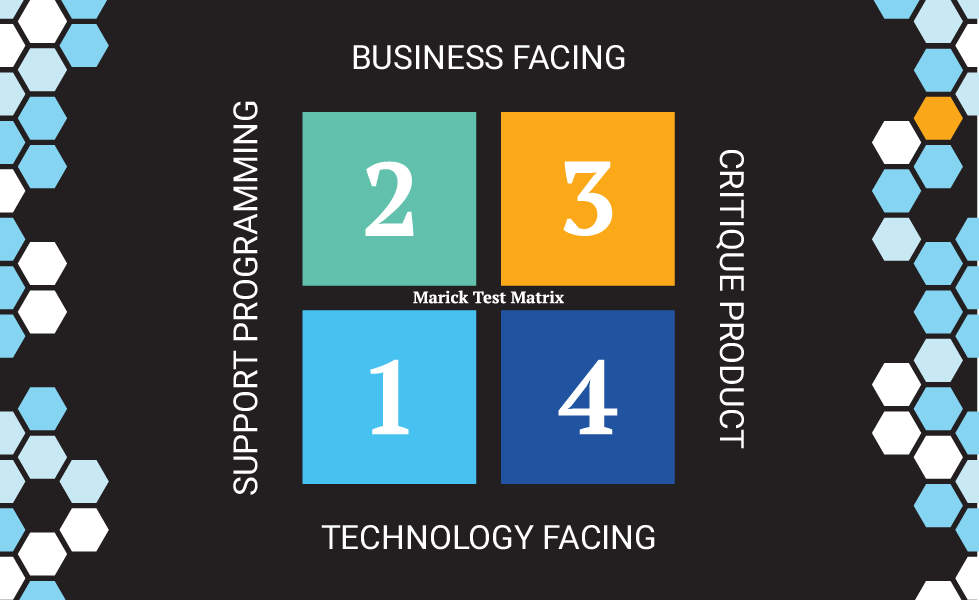
Marick's testing quadrant provides strategic guidance, not a checklist of tasks.
Post by Dec 15, 2025 8:42:42 AM · 4 min read

The Quadrant Trap

Teams that turn Marick’s Agile Testing Quadrants into a box-checking exercise undermine the strategic, collaborative thinking required for real software quality.

TABLE OF CONTENTS

Why Treating Marick's Matrix as a Checklist Kills True Quality

Brian Marick's Agile Testing Quadrants have become one of the most referenced frameworks in software testing. Walk into any testing discussion, and someone will inevitably sketch out the 2x2 matrix on a whiteboard. But here's the problem: we've turned a strategic map into a checklist, and in doing so, we've entirely missed the point.

The Model's Intent vs. Reality

Marick designed the quadrants as a strategic map - a way to visualize different testing perspectives and facilitate conversations about comprehensive quality. The framework was meant to help teams ask: "Are we considering all these different angles? Are we having the right conversations about quality?"

But that's not how teams use it.

Instead, the quadrants have become four discrete boxes to check off. Teams treat them like a compliance exercise: "We have unit tests in Q1? Check. Some BDD scripts in Q2? Check. Manual testing in Q3? Check. One performance test we run before major releases in Q4? Check. We're done here."

This reduction from strategic thinking to box-checking fundamentally misses what Marick was trying to accomplish.

Blind Spot: The Illusion of Coverage

Here's where the quadrant trap becomes dangerous. Teams look at their testing matrix and convince themselves they have comprehensive coverage:

"We have 100 unit tests (Q1), a handful of BDD scripts (Q2), manual testing every sprint (Q3), and we run a load test once a year (Q4). All four quadrants are covered. We're good."

But the quadrants define type, not depth. They tell you nothing about whether your testing is actually effective.

100 poorly written unit tests that only verify happy paths are worse than 10 well-designed tests that expose actual risks. A single exploratory testing session by someone who deeply understands user workflows can uncover more critical issues than dozens of shallow manual test runs following scripts.

The framework provides no guidance on the required density, frequency, or quality of testing within each quadrant. It can't tell you if your Q1 coverage is adequate or if your Q4 performance testing actually reflects production conditions.

Yet teams use the quadrants to declare victory: "Look, we're testing in all four quadrants!" Meanwhile, their production systems are failing in ways their "comprehensive" testing never anticipated.

Misuse: The Quadrant Silo Problem

Perhaps the most damaging misuse of the quadrants is using them to define organizational boundaries:

  • Developers own Q1 (unit tests)
  • Business analysts own Q2 (acceptance tests)
  • Testers own Q3 (exploratory/manual testing)
  • Performance engineers own Q4 (non-functional testing)

This interpretation creates artificial silos that prevent precisely the kind of cross-functional collaboration the quadrants were meant to encourage.

Quality doesn't respect quadrant boundaries. A developer writing unit tests (Q1) should be informed by the user scenarios and acceptance criteria defined in Q2 - that's the entire point of BDD done right. Exploratory testers (Q3) need insights from automated tests to understand what's already been verified so they can focus their exploration on gaps and risks. The quadrants work together, not in isolation.

The quadrants are meant to facilitate dialogue, not define specialization.

When you assign ownership by quadrant, you end up with developers who think quality ends at their unit tests, testers who feel no ownership over automated testing, and business analysts who write acceptance criteria without understanding system constraints.

The framework becomes a way to avoid collaboration rather than enable it.

The Shift-Left Failure: Misunderstanding Prevention vs. Detection

Here's the final trap: teams use the quadrants to justify their existing bad habits, particularly the over-reliance on late-stage manual testing.

Many organizations look at their testing distribution and see heavy investment in Q3 (manual/exploratory testing) with minimal effort in Q1 and Q2. They convince themselves this is fine because "we're covering all the quadrants."

But this completely misses the preventative vs. detective nature of the quadrants.

Q1 and Q2 testing - the "supporting the team" quadrants - are fundamentally about preventing defects from being built in the first place. Strong unit tests catch logic errors before they propagate. Good acceptance tests ensure features are built right from the start.

When Q1 and Q2 are weak, Q3 and Q4 become expensive, late-stage bug-hunting operations rather than product critique and validation. You're not exploring to understand the product better - you're just finding the defects that should have been caught earlier.

The quadrants aren't suggesting equal distribution of effort. They're implying that strategic investment early (Q1/Q2) makes later testing (Q3/Q4) more valuable because you're critiquing a higher-quality product rather than debugging a broken one.

The Way Forward

The quadrants are valuable, but only if we use them as Marick intended: as a prompt for strategic thinking, not as a checklist for organizational compliance.

Stop asking "Do we have testing in all four quadrants?"

Start asking:

  • Are our Q1/Q2 tests actually preventing defects or just creating false confidence?
  • Is our exploratory testing (Q3) informed by what we've learned in other quadrants?
  • Are we testing non-functional requirements (Q4) throughout development or only at the end?
  • Are we having cross-quadrant conversations about quality, or have we siloed our testing by framework box?

The quadrant trap is seductive because it makes quality look simple and measurable. But quality has never been simple, and the moment we start treating it as a checklist, we've already lost.

About the Author

Rafael E Santos is Testaify's COO. He's committed to a vision for Testaify: Delivering Continuous Comprehensive Testing through Testaify's AI-first testing platform.Testaify founder and COO Rafael E. Santos is a Stevie Award winner whose decades-long career includes strategic technology and product leadership roles. Rafael's goal for Testaify is to deliver comprehensive testing through Testaify's AI-first platform, which will change testing forever. Before Testaify, Rafael held executive positions at organizations like Ultimate Software and Trimble eBuilder.

Take the Next Step

Testaify is in managed roll-out. Request more information to see when you can bring Testaify into your testing process.