
AI coding may be sexier, but as software velocity explodes, testing is still essential to prevent defects from overwhelming modern development workflows.
TABLE OF CONTENTS
Testing isn’t sexy. Software defects aren’t either.
Let’s just say it out loud. AI coding tools are sexy. Watching an AI generate an application from a prompt in thirty seconds feels like the sci-fi world of the future has finally arrived. Autonomous agents writing code, chaining tools together, deploying apps, and “vibe coding” entire products into existence? That gets attention.
Well, it should! It’s cool! The speed increase is real. Software development has changed dramatically in the last two years, and it’s still accelerating. Developers are writing more code than ever! Entire workflows that used to take days, weeks, or months now happen in hours. Sometimes minutes.
But there’s a less glamorous side to this story that nobody posts cinematic demos about: Somebody still has to validate all this software. And right now, testing is struggling to keep up. Worse still, some organizations are acting as if AI can somehow validate itself as it writes. Testing budgets shrink, QA teams contract, but release pressure keeps increasing. (If you missed Rafael’s blog, When Two Layoffs Tell the Same Story, it’s a must-read.)
Because while AI has transformed code generation, most testing workflows still operate as if development hadn’t fundamentally changed. That’s the gap we’ve been focused on at Testaify.
Not: “How do we automate scripted testing a little faster?” But: What happens when software generation accelerates beyond what traditional testing workflows can realistically validate? That question forced us to rethink the platform.
So over the last several months, we refactored Testaify into something much broader than autonomous test execution alone.
Portfolio Health
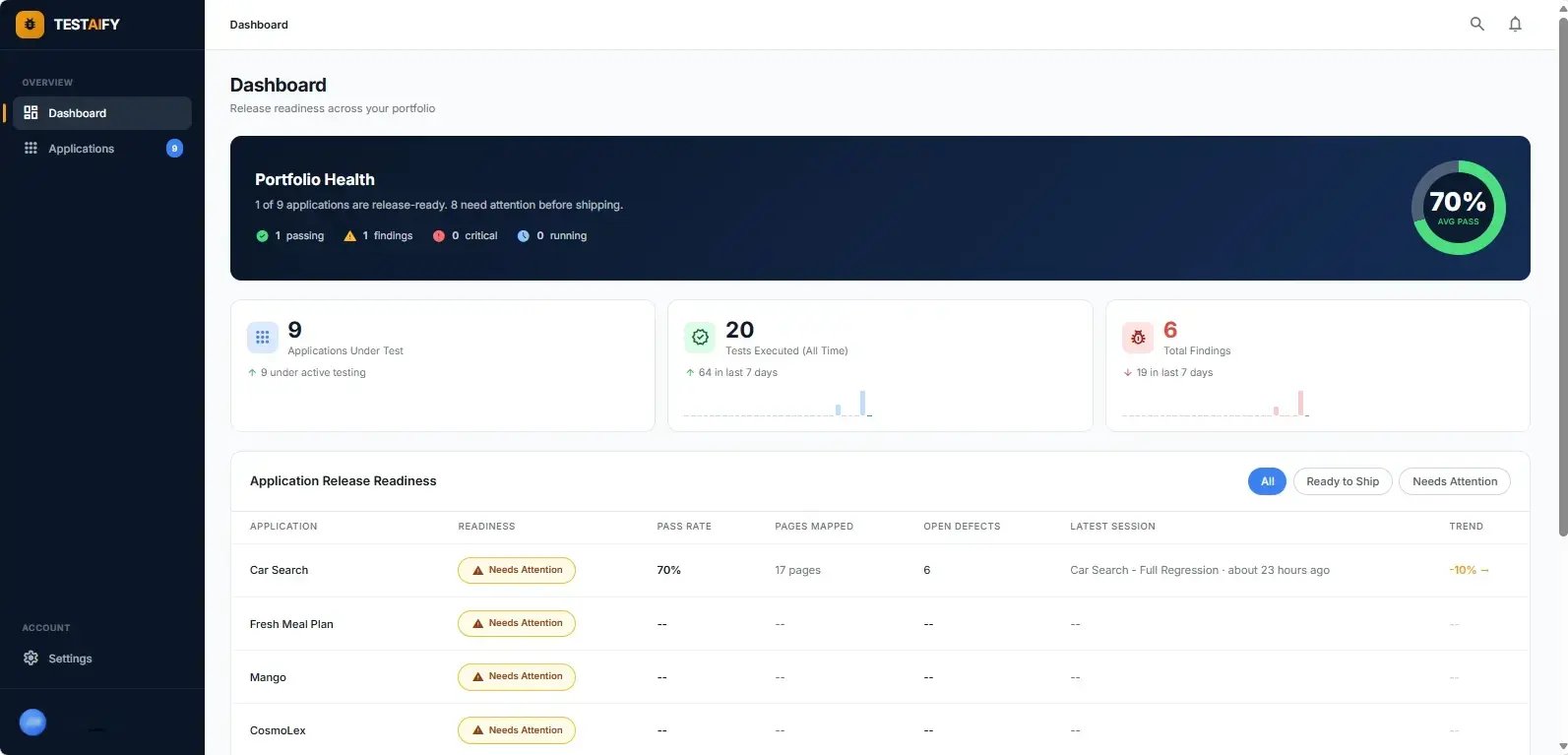
Testaify 2.0 introduces a portfolio-level operational view designed to help teams understand not just whether tests ran, but whether applications are actually ready to ship.
Testaify 2.0 introduces:
- broader testing methodologies
- configurable testing depth
- CI/CD integration
- stronger reporting and replay
- release readiness workflows
- application intelligence mapping
- AI learning across sessions
- developer-focused troubleshooting
- operational controls for modern engineering teams
And we’re still shipping new capabilities every week. But Testaify’s biggest breakthrough overall wasn’t adding more buttons. It was solving web app discovery. Most automated testing systems still depend heavily on predefined paths, scripted assumptions, or rigid workflows. They struggle when applications become dynamic, unpredictable, or simply built differently from what was expected.
Humans don’t test that way. A good tester explores. Investigates. Experiments. Pushes boundaries. Chooses weird paths. Tries things that “shouldn’t” happen. That’s the behavior we wanted our AI workers to emulate.
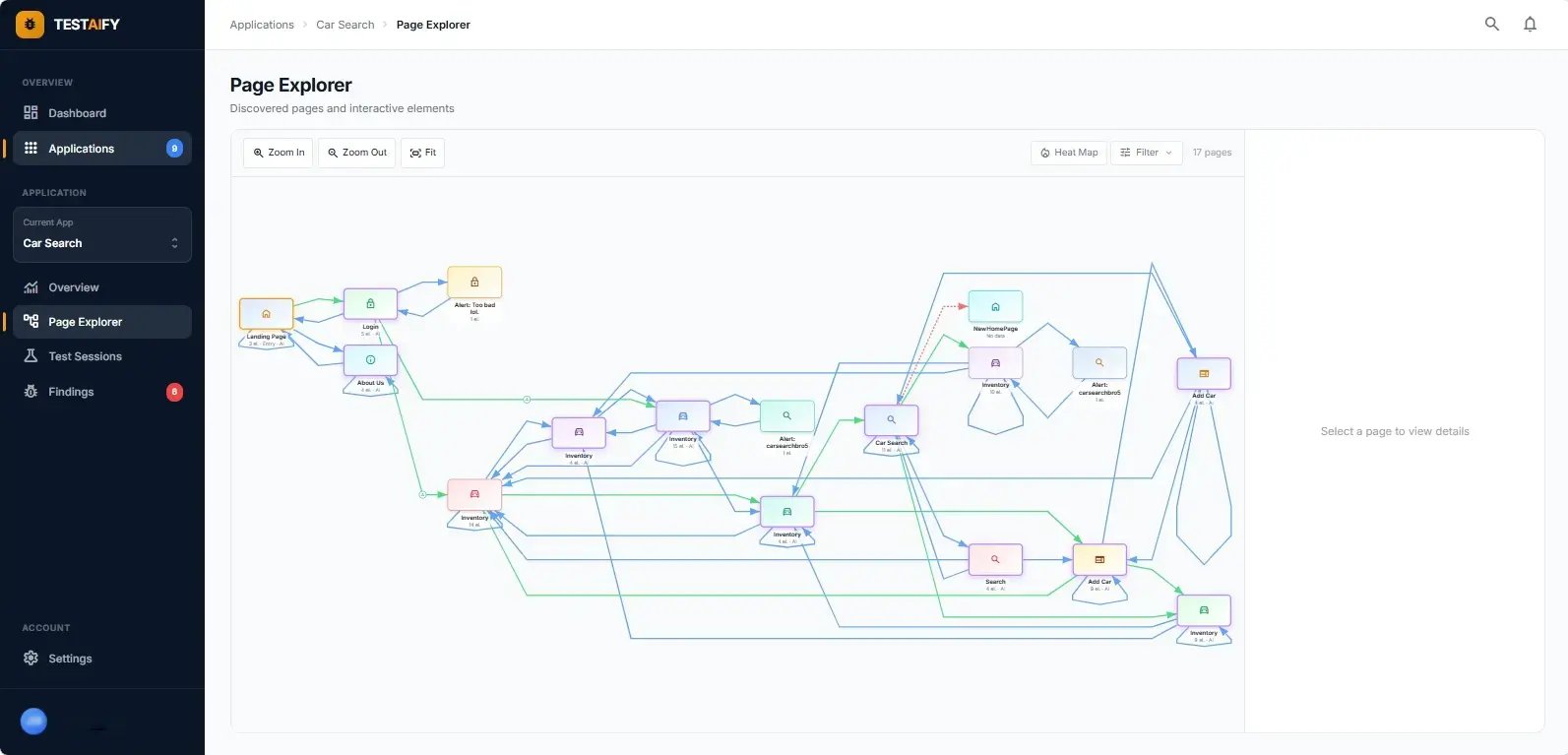
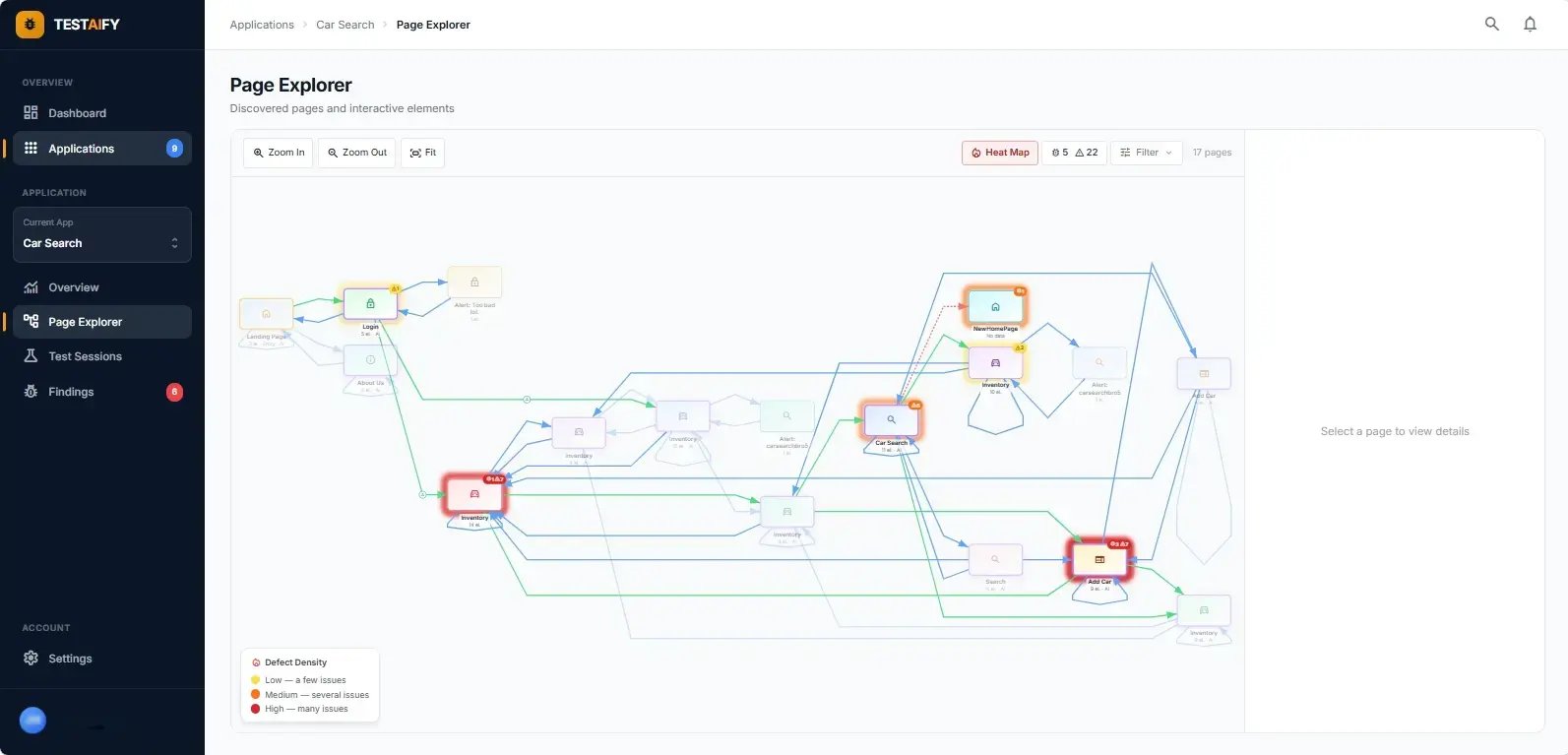
Testaify’s autonomous workers investigate applications more like a person would — exploring workflows, building an understanding of the system, identifying connected behaviors, and dynamically generating tests based on what they discover. You can filter this map to glean important insights into how your application was discovered, following tested paths, spotlighting broken paths, and seeing inbound and outbound connections for every page.
Page Explorer
Map Filters
Instead of blindly replaying scripts, Testaify continuously maps the application as it explores, learns which workflows have been tested, tracks connected paths, and identifies areas that deserve deeper investigation.
Heat Mapping
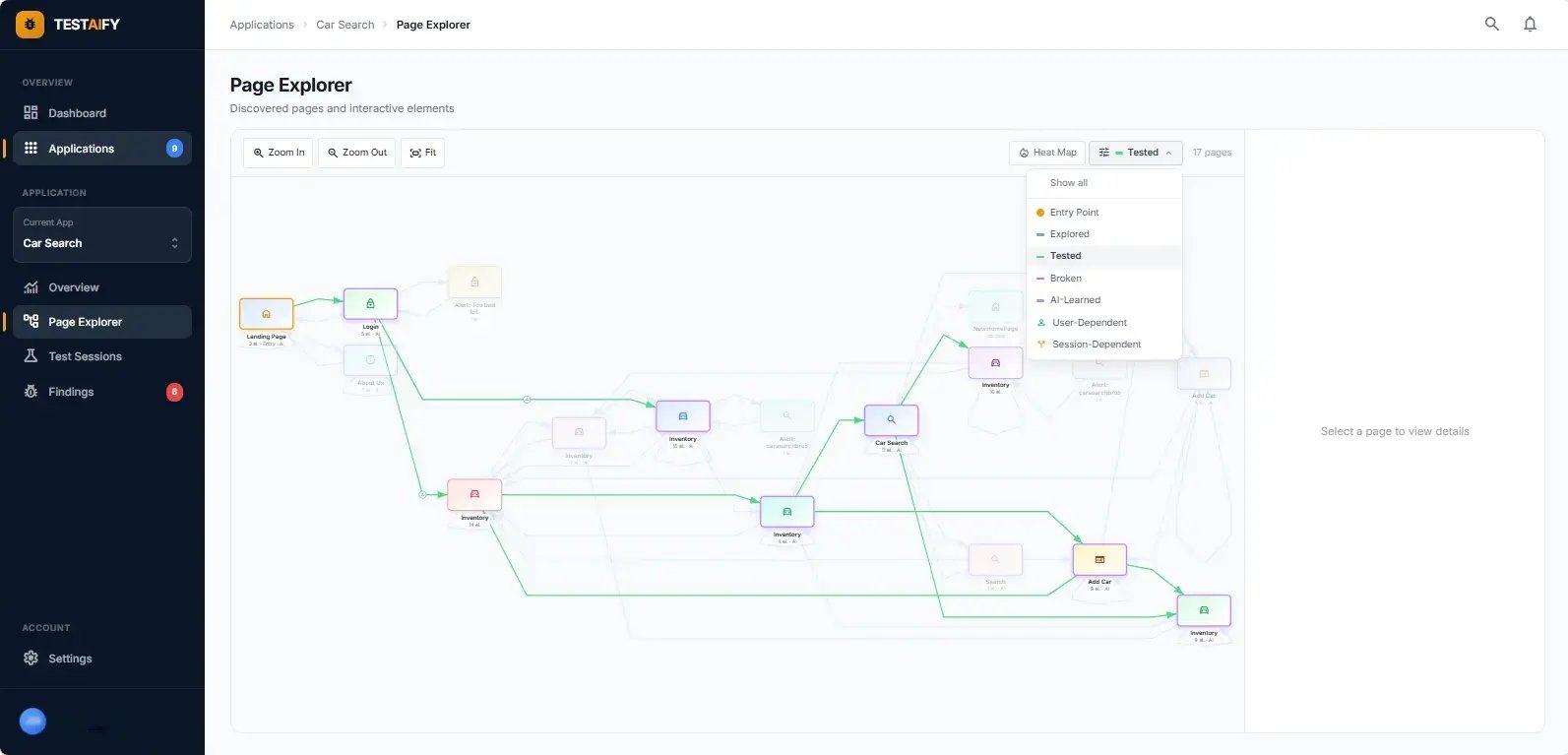
Testaify 2.0 includes our most useful visual application map ever: a heat map that shows where issues are concentrated. Testaify 2.0 also includes operational release intelligence, autonomous findings management, replay capabilities, and broader system awareness than traditional scripted automation can realistically maintain.
Test Session Configuration and CI/CD Integration
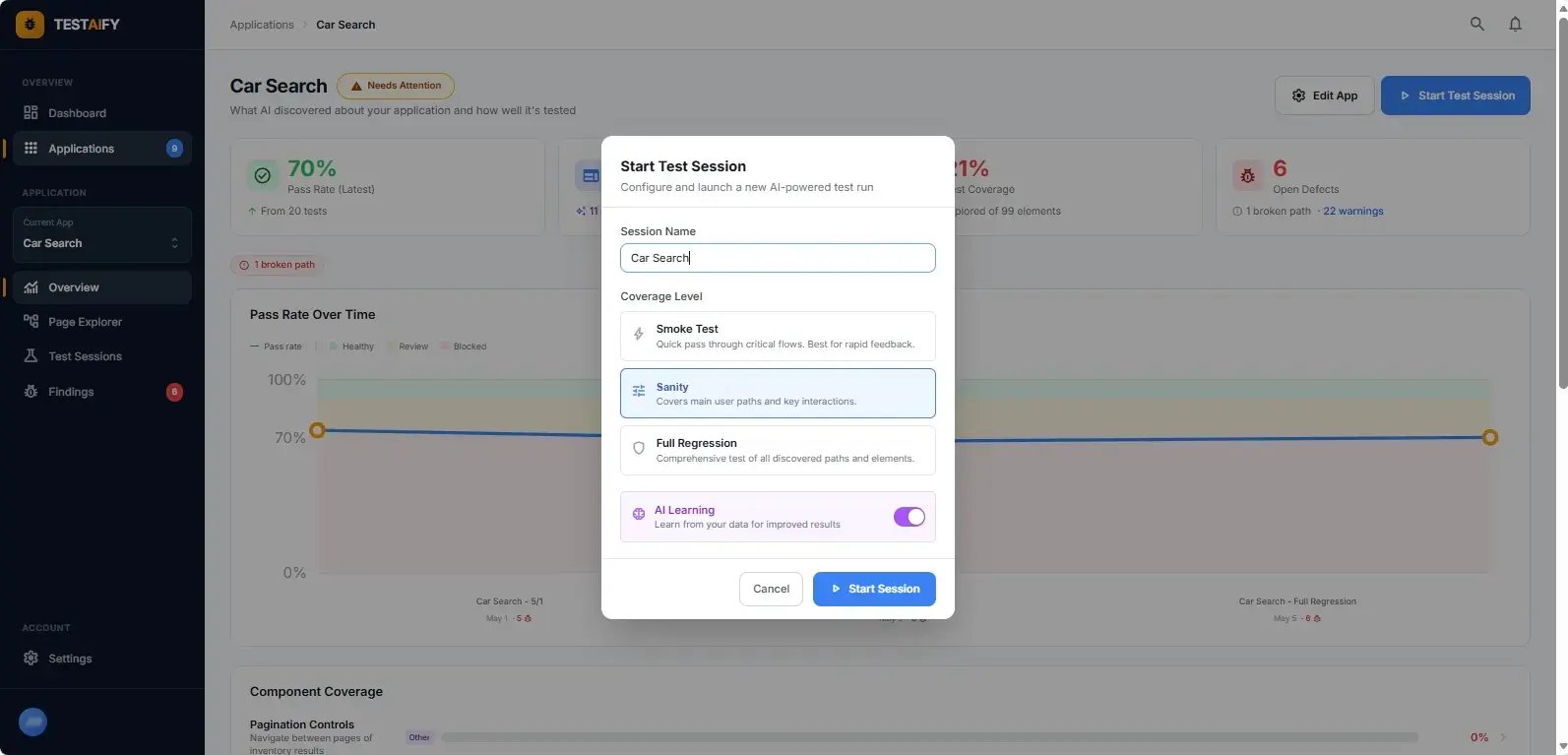
Teams can now configure testing depth from smoke to full regression, enable AI learning between sessions, and integrate testing workflows directly into CI/CD pipelines. Because AI-generated software requires AI-assisted validation, too.
Otherwise, development becomes asymmetrical:
- Code generation accelerates
- Testing bottlenecks harden
- Release confidence drops
- Defects accumulate behind green pipelines
And eventually, somebody pays for that speed in production.
Defect Analysis
And when something breaks, Testaify doesn’t stop at “test failed.”
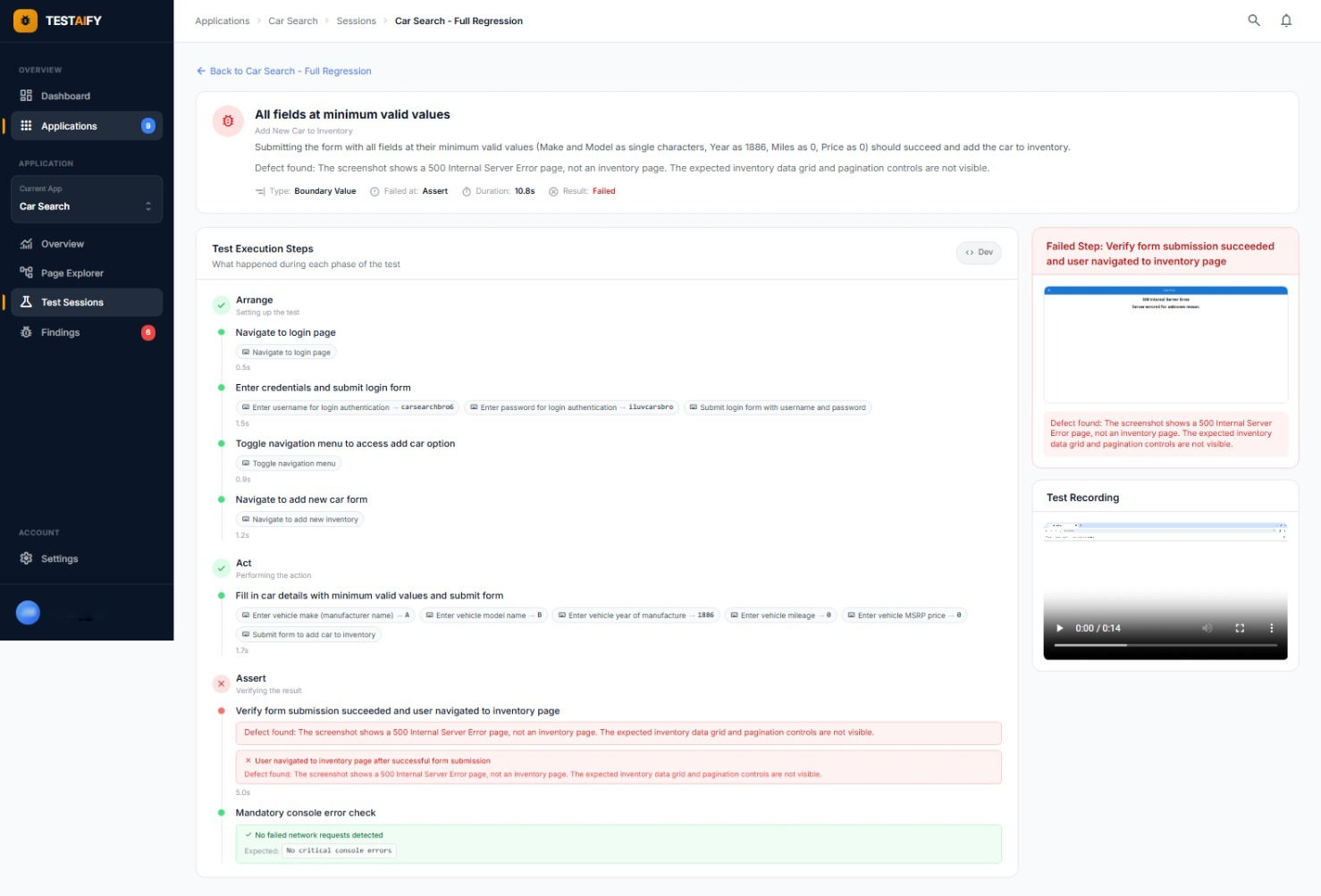
Teams can review execution steps, assertions, screenshots, replay recordings, and detailed findings to understand exactly what happened, where the application failed, and why it matters. Developer-level details make issue resolution faster and easier, and can be toggled on and off.
I know it, you know it, we all know it: testing will never be as flashy or exciting as autonomous coding demos on social media. That’s fine. The point isn’t whether testing can be sexy. The point is whether your software actually works. And in an era where AI is generating more software than ever before, autonomous validation stops being optional surprisingly fast.
That’s the future we’re building toward with Testaify 2.0. Maybe that’s pretty sexy after all!
See Testaify 2.0 in Action
Experience unlimited autonomous testing for $499 per web app/month. Book a quick walkthrough and get started testing today.
Testing isn’t sexy. Software defects aren’t either.
Let’s just say it out loud. AI coding tools are sexy. Watching an AI generate an application from a prompt in thirty seconds feels like the sci-fi world of the future has finally arrived. Autonomous agents writing code, chaining tools together, deploying apps, and “vibe coding” entire products into existence? That gets attention.
Well, it should! It’s cool! The speed increase is real. Software development has changed dramatically in the last two years, and it’s still accelerating. Developers are writing more code than ever! Entire workflows that used to take days, weeks, or months now happen in hours. Sometimes minutes.
But there’s a less glamorous side to this story that nobody posts cinematic demos about: Somebody still has to validate all this software. And right now, testing is struggling to keep up. Worse still, some organizations are acting as if AI can somehow validate itself as it writes. Testing budgets shrink, QA teams contract, but release pressure keeps increasing. (If you missed Rafael’s blog, When Two Layoffs Tell the Same Story, it’s a must-read.)
Because while AI has transformed code generation, most testing workflows still operate as if development hadn’t fundamentally changed. That’s the gap we’ve been focused on at Testaify.
Not: “How do we automate scripted testing a little faster?” But: What happens when software generation accelerates beyond what traditional testing workflows can realistically validate? That question forced us to rethink the platform.
So over the last several months, we refactored Testaify into something much broader than autonomous test execution alone.
Portfolio Health
Testaify 2.0 introduces a portfolio-level operational view designed to help teams understand not just whether tests ran, but whether applications are actually ready to ship.
Testaify 2.0 introduces:
- broader testing methodologies
- configurable testing depth
- CI/CD integration
- stronger reporting and replay
- release readiness workflows
- application intelligence mapping
- AI learning across sessions
- developer-focused troubleshooting
- operational controls for modern engineering teams
And we’re still shipping new capabilities every week. But Testaify’s biggest breakthrough overall wasn’t adding more buttons. It was solving web app discovery. Most automated testing systems still depend heavily on predefined paths, scripted assumptions, or rigid workflows. They struggle when applications become dynamic, unpredictable, or simply built differently from what was expected.
Humans don’t test that way. A good tester explores. Investigates. Experiments. Pushes boundaries. Chooses weird paths. Tries things that “shouldn’t” happen. That’s the behavior we wanted our AI workers to emulate.
Testaify’s autonomous workers investigate applications more like a person would — exploring workflows, building an understanding of the system, identifying connected behaviors, and dynamically generating tests based on what they discover. You can filter this map to glean important insights into how your application was discovered, following tested paths, spotlighting broken paths, and seeing inbound and outbound connections for every page.
Page Explorer
Map Filters
Instead of blindly replaying scripts, Testaify continuously maps the application as it explores, learns which workflows have been tested, tracks connected paths, and identifies areas that deserve deeper investigation.
Heat Mapping
Testaify 2.0 includes our most useful visual application map ever: a heat map that shows where issues are concentrated. Testaify 2.0 also includes operational release intelligence, autonomous findings management, replay capabilities, and broader system awareness than traditional scripted automation can realistically maintain.
Test Session Configuration and CI/CD Integration
Teams can now configure testing depth from smoke to full regression, enable AI learning between sessions, and integrate testing workflows directly into CI/CD pipelines. Because AI-generated software requires AI-assisted validation, too.
Otherwise, development becomes asymmetrical:
- Code generation accelerates
- Testing bottlenecks harden
- Release confidence drops
- Defects accumulate behind green pipelines
And eventually, somebody pays for that speed in production.
Defect Analysis
And when something breaks, Testaify doesn’t stop at “test failed.”
Teams can review execution steps, assertions, screenshots, replay recordings, and detailed findings to understand exactly what happened, where the application failed, and why it matters. Developer-level details make issue resolution faster and easier, and can be toggled on and off.
I know it, you know it, we all know it: testing will never be as flashy or exciting as autonomous coding demos on social media. That’s fine. The point isn’t whether testing can be sexy. The point is whether your software actually works. And in an era where AI is generating more software than ever before, autonomous validation stops being optional surprisingly fast.
That’s the future we’re building toward with Testaify 2.0. Maybe that’s pretty sexy after all!
See Testaify 2.0 in Action
Experience unlimited autonomous testing for $499 per web app/month. Book a quick walkthrough and get started testing today.
About the Author
 Lisa Fatolitis, Testaify's marketing director, is excited to be with this team on the front lines of the AI revolution. She has an MBA with a marketing emphasis and a BA in Medieval History, two cats, and loves designing marketing programs that unite products with the people who need them. Lisa is a certified product owner.
Take the Next Step
Book a walkthrough to see how bringing Testaify to your development process will save time and help you push quality forward!