When Two Layoffs Tell the Same Story
AI is rapidly collapsing manual QA as a career path and shrinking QA teams, but the companies that win will be the ones that use autonomous testing to replace execution while keeping human testers focused on strategy, risk, and judgment.
TABLE OF CONTENTS
A couple of recent events have been rattling around in my head.
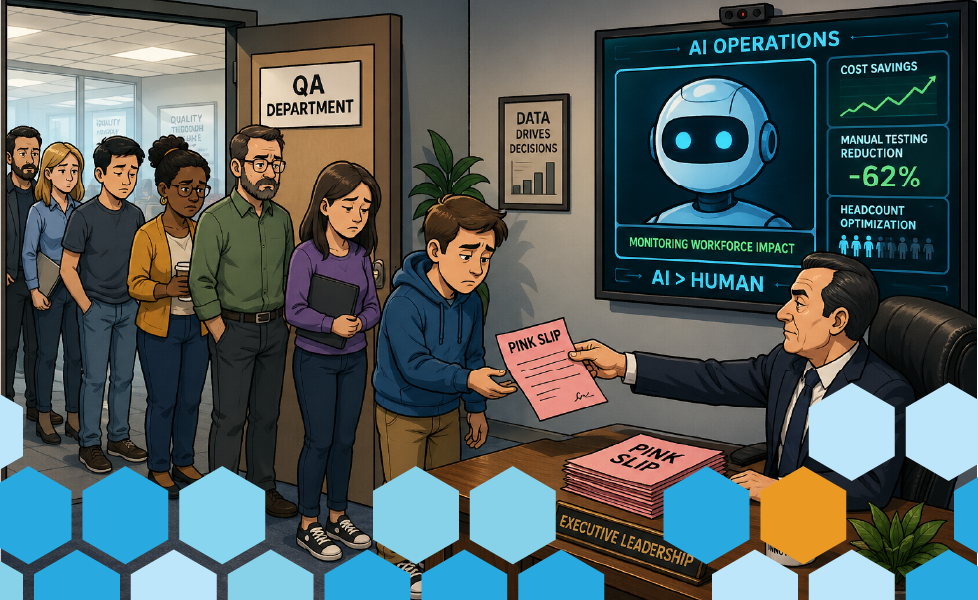
The first one happened recently. UKG announced it was laying off 950 people. But here's the part that stuck with me: the day before the layoffs, UKG sent an email to the entire company telling everyone that 950 people would be let go the next day. Not telling them who. Just telling them to wait and find out tomorrow.
Imagine that night. Thousands of people are going home, hugging their kids, wondering if tomorrow is the day. Thousands of partners ask, "Did you hear anything?" and get, "Not yet." A whole company, held hostage overnight by a leadership team that apparently couldn't figure out a more humane way to do this.
I used to work at Ultimate Software, before it merged with Kronos and became UKG. I was Director of QA and VP of Software Engineering. The Ultimate Software leadership I knew would never have done this. They cared about people. They built the Ultimate Software culture on respect. What happened at UKG would have been unthinkable there. The UKG leadership is clueless.
The second event was earlier this year. Atlassian announced layoffs that explicitly targeted QA roles. Atlassian. A company with a culture I've admired for years. Thoughtful founders. Good people. And even they are now openly restructuring around AI.
Those two events didn't happen in the same week. But they collided in my head. Because when a company with a famously bad culture cuts people around AI, you shrug. When a company with a famously good culture does the same thing, you pay attention.
And the pattern is the same: AI is changing what a QA team is supposed to look like. Everyone is adjusting. The question is whether they're adjusting intelligently or just panicking.
The Numbers Are Louder Than the Press Releases
Here's what the Bureau of Labor Statistics will tell you. Software QA analysts and testers held about 201,700 jobs in 2024, and the combined developer/QA category is projected to grow 15% through 2034. Sounds healthy.
It isn't.
The BLS bundles QA with developers in its projections. That bundling hides what's happening inside the QA slice. And inside the QA slice, manual testing roles have collapsed. One industry analysis put the decline at 43% since 2023:
"The bar for entry-level QA positions has risen dramatically. Manual testing roles have declined by 43% since 2023, and those positions that remain often pay significantly less than before." — Prepare.sh, "QA and SDET in the AI Boom" (March 2025)
A 43% decline is not a correction. It's a restructuring of the profession.
Atlassian Said the Quiet Part Out Loud
Most companies don't name AI when they cut people. They say "restructuring." They say "efficiency." They say "aligning resources."
Atlassian said it directly:
"Atlassian's layoffs specifically targeted QA roles, with the company stating that AI tools had reduced the need for manual testing by approximately 60%." — tech-insider.org, "Tech Layoffs 2026" (April 2026)
Sixty percent. From a company with a great engineering culture.
And UKG? Their CEO, Jennifer Morgan, has been openly transforming the company into what she calls an "AI-first company." That's the stated strategy. They are panicking.
That's the pattern. Good cultures, bad cultures, it doesn't matter. AI is redrawing the org chart, and QA is one of the first lines to get redrawn.
Why AI Is Hitting QA So Hard
I've thought about this a lot. AI is reshaping development, too — that's obvious. But the impact on QA has its own shape, and it's worth being specific about why.
Testing is structured work. Test cases describe what should happen. They're literally specifications. And specifications are exactly what AI models do well. A tester clicking through a regression suite is doing work that AI is particularly well-suited to take over.
The economics are brutal. A mid-sized QA team costs a million dollars or more per year. Against an AI platform at a fraction of that cost — with broader coverage — it's not a debate. It's a budget meeting.
And adoption is already here. The 2024/25 World Quality Report found that 64% of organizations are either using AI for QA or building an implementation roadmap. Only 4% have no plans at all. When two-thirds of the market is moving, the rest don't get to opt out.
The Counter-Story Nobody Wants to Talk About
Now, before anyone declares QA dead, here's the part that matters.
A few days ago, QA Financial reported on a bank that replaced its QA team with AI. Then it shipped a zero-price discount bug. The cost? Six million dollars.
"Cutting testers may reduce visible headcount costs in the short term, but it can also remove institutional memory, weaken challenge and review, and leave no one in place to question outputs that appear technically plausible but commercially disastrous." — QA Financial (April 2026)
That's the counter-story. Companies that treat AI as a total replacement for human judgment are going to learn — expensively — that execution and judgment are different things.
The real shift is not "AI replaces QA." The real shift is that the shape of a QA team is being rebuilt. Smaller. More senior. More focused on risk, strategy, and interpretation. Less focused on writing and maintaining scripts.
The 10-person manual QA team of 2023 isn't coming back. But a 2-person QA strategy team running an autonomous testing platform? That team is hiring.
Where We'll Be in Two Years
Here's what I think the QA world looks like in 2028. I'll probably be wrong on the details. I don't think I'll be wrong on the direction.
Manual testing as a career path will be gone. The 43% decline from 2023 will look mild. Junior manual QA jobs — the traditional on-ramp into the profession — will mostly disappear outside of regulated industries.
QA headcount at most companies will be a fraction of what it was. Not zero. Never zero. But dramatically smaller and made up of different people. A small number of very senior quality strategists at the top, and the AI platform doing the volume work.
The "QA Engineer" title will split. I expect it to fragment into three roles: Quality Strategist (owns test strategy and risk), Test Platform Engineer (owns the AI testing infrastructure), and AI Quality Specialist (tests the AI systems themselves — hallucinations, bias, guardrails). The generalist manual tester role? That one isn't making it.
Autonomous testing becomes the default. Today, the question is "Are you using AI for testing?" In two years, it'll be "do you have a human in the loop at all?" And for most companies, the answer will be yes — but only at the strategy and interpretation layer.
More companies will learn the $6M lesson. More cautionary tales are coming. The companies that survive this transition will be the ones that figured out AI doesn't eliminate the need for quality ownership. It just changes where that ownership lives.
The Real Message for QA Folks
If you're a QA person reading this — and especially if you're one of the UKG folks who got that email — here's what I'd say.
Your value was never in executing test cases. It was in understanding what quality means for a specific product, for specific users, for a specific business. AI can execute. It can't — yet — decide what's worth executing. It can't tell a product manager that the login flow "technically works" but feels wrong. It can't look at a release and say, "I don't care what the tests say, something's off."
That's the work. That's where the profession is going.
The testers who'll thrive in 2028 are the ones who figured out in 2026 that the click-through-scripts job was already gone. The strategy job, the risk job, the interpretation job — those are still here. Those are growing. And they pay better than the old job did.
The industry owes many people a better transition than "we'll let you know tomorrow which of you is done." It's not going to deliver one. So the only thing left is to see the shift clearly and move first.
At Testaify, we built our platform around the idea that AI handles discovery, design, execution, and reporting end-to-end — while humans own the strategy, the risk calls, and the interpretation. That division of labor isn't a compromise. It's the only one that actually works.
About the Author
 Testaify founder and COO Rafael E. Santos is a Stevie Award winner whose decades-long career includes strategic technology and product leadership roles. Rafael's goal for Testaify is to deliver comprehensive testing through Testaify's AI-first platform, which will change testing forever. Before Testaify, Rafael held executive positions at organizations like Ultimate Software and Trimble eBuilder.
Take the Next Step
Testaify is in managed roll-out. Request more information to see when you can bring Testaify into your testing process.